
Losing a tooth can change more than your smile. It can affect how you chew, how you speak, and even how confident you feel in everyday conversations. If you are weighing a dental bridge vs implant, the right choice often comes down to your oral health, your timeline, and what will support your smile for the long term.
Both options are trusted ways to replace a missing tooth. Both can restore function and appearance. But they work very differently, and that difference matters.
Dental bridge vs implant: the basic difference
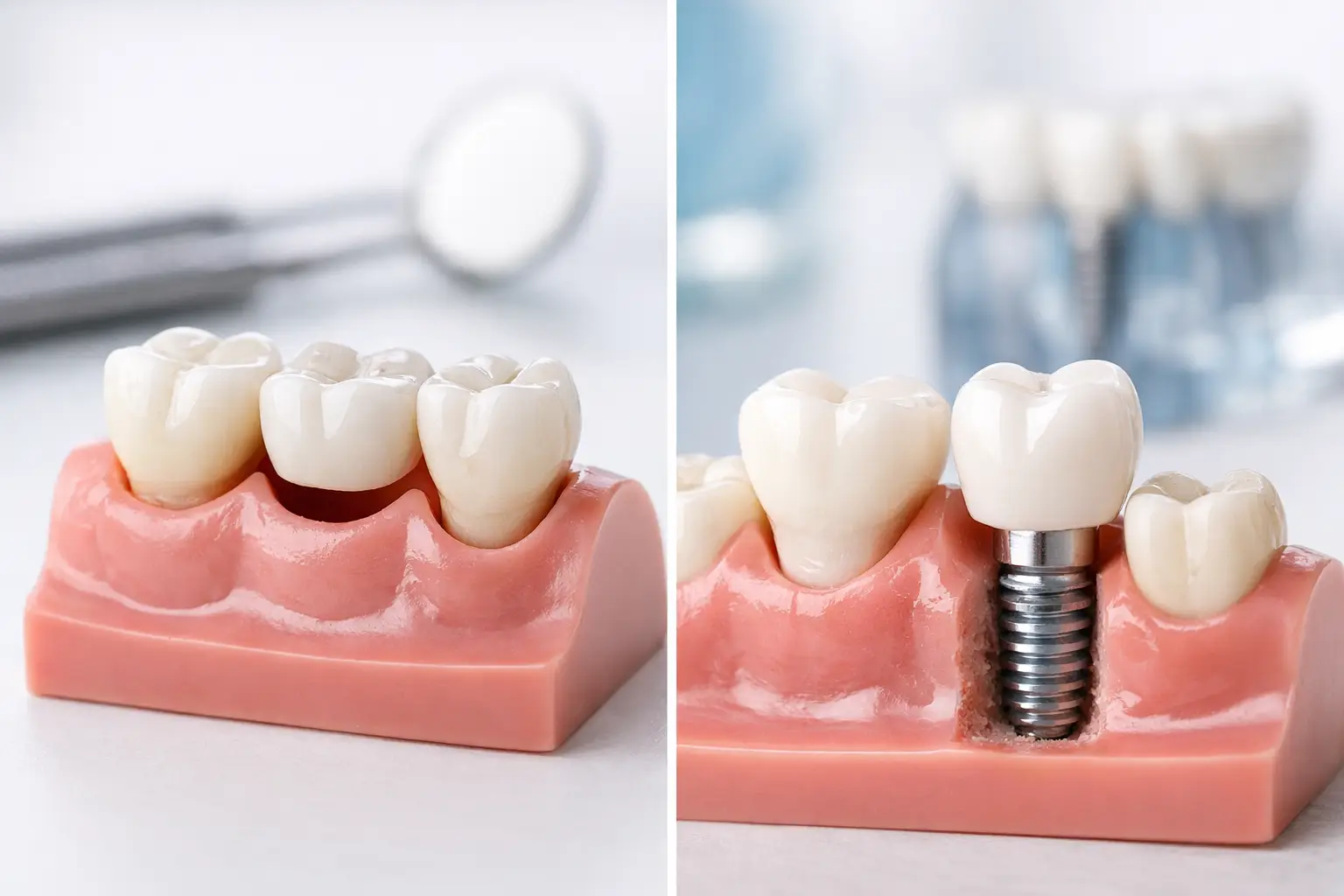
A dental bridge replaces a missing tooth by using the teeth on either side for support. In a traditional bridge, those neighbouring teeth are prepared so crowns can anchor an artificial tooth in the middle. The bridge is fixed in place and does not come out.
A dental implant replaces the tooth root as well as the visible tooth. A small titanium post is placed into the jawbone, where it heals and integrates with the bone over time. Once the area is ready, a custom crown is attached on top.
The simplest way to think about it is this: a bridge spans the gap, while an implant replaces the missing tooth more independently.
When a bridge may make more sense
A dental bridge can be an excellent option in the right situation. For some patients, it offers a faster path to restoring the smile and bite, especially when the teeth beside the space already need crowns or significant restoration.
A bridge may be worth considering if you want a shorter treatment timeline. Since there is no surgical placement into the bone, treatment can often move more quickly than an implant process. That can be appealing when the missing tooth is in a visible area or when chewing is uncomfortable.
It can also make sense when an implant is not ideal because of bone loss, certain medical considerations, or personal preference. Not everyone wants surgery, even a routine one, and that is a valid factor in treatment planning.
That said, a bridge depends on neighbouring teeth for support. If those teeth are healthy and untouched, preparing them may feel like a bigger compromise.
When an implant may be the better choice
A dental implant is often the closest option to replacing a natural tooth. Because it stands on its own, it does not rely on the teeth beside it. That can help preserve more of your natural tooth structure.
Implants also support the jawbone in a way a bridge cannot. After a tooth is lost, the bone in that area can begin to shrink over time because it is no longer being stimulated by the tooth root. An implant helps maintain that stimulation, which can support long-term oral health and facial structure.
For many adults, that long-term benefit is a major reason to choose an implant. If you are looking at the big picture and want a replacement that is designed to function more like a natural tooth, an implant often stands out.
Still, implant treatment takes longer. Healing time is part of the process, and in some cases bone grafting or other preparatory treatment may be needed before placement.
How dental bridge vs implant compares in daily life
From a comfort and function standpoint, both options can feel very natural once treatment is complete. Most patients adjust well and are able to eat and smile confidently.
An implant tends to feel more like an individual tooth because it is anchored in the jaw. A bridge is also fixed and stable, but the way it distributes bite forces is different because it is supported by adjacent teeth.
Cleaning is another practical difference. An implant is brushed and flossed much like a natural tooth, although good technique still matters. A bridge requires a little more effort to clean underneath the false tooth, often with floss threaders or other tools. It is manageable, but it does add a step to your hygiene routine.
For some patients, that extra maintenance is not a concern. For others, especially those who already find flossing challenging, it is something to consider honestly.
Cost matters, but so does value over time
Many people first compare these options by cost, and that is understandable. In general, a bridge may have a lower upfront cost than a single implant. But upfront cost is only one part of the decision.
A bridge may eventually need replacement, particularly if the supporting teeth develop decay, wear, or other issues. An implant can also require maintenance, and no dental treatment lasts forever, but implants often offer strong long-term value because they preserve bone and do not place the same demands on neighbouring teeth.
This is where personalized planning matters. A lower initial fee is not always the most economical choice over many years. On the other hand, an implant is not automatically the better investment for every patient. Your oral condition, habits, medical history, and goals all shape what value really looks like.
The health of nearby teeth can change the answer
One of the biggest deciding factors is the condition of the teeth next to the gap.
If those teeth are already heavily filled, cracked, or in need of crowns, a bridge may fit naturally into the treatment plan. In that case, using them to support a bridge may not require much additional compromise.
If the neighbouring teeth are healthy and intact, an implant often becomes more attractive because it leaves those teeth alone. Preserving natural tooth structure is a priority whenever possible.
This is why there is no one-size-fits-all answer to dental bridge vs implant. The same missing tooth can lead to different recommendations for two different patients.
Bone health and timing are important
Jawbone support is a major factor in implant planning. If a tooth has been missing for some time, the bone in that area may have thinned. That does not always rule out an implant, but it may mean extra treatment is needed.
A bridge does not require the same bone support because it does not sit in the jawbone. That can make it a practical option when time, anatomy, or health factors make implant treatment less straightforward.
Timing after tooth loss can matter too. In some situations, moving ahead with replacement sooner helps preserve options and may simplify treatment. Waiting too long can allow shifting, bite changes, or bone loss to develop.
What the treatment process feels like
Many patients are less worried about the final result than about the process itself. That is completely normal.
A bridge usually involves preparing the supporting teeth, taking scans or impressions, and then placing the final restoration once it is ready. The process is familiar to many dental patients and may feel more approachable if you prefer to avoid surgery.
An implant involves placing the implant post first, then allowing time for healing before the final crown is attached. While implant surgery is common and carefully planned, it is still a surgical procedure, and some patients need time to feel comfortable with that idea.
A calm, clear conversation with your dental team can make a big difference here. When you understand what to expect, treatment tends to feel much less overwhelming.
Aesthetic results and long-term confidence
Both bridges and implants can look beautiful when they are carefully designed. Shape, shade, and fit all matter. In the front of the mouth especially, the goal is not just replacing a tooth, but creating a result that feels natural in your smile.
Implants can offer advantages in maintaining gum and bone contours over time, particularly in some visible areas. Bridges can also provide excellent cosmetic results, but the surrounding tissues may change differently over the years because there is no implant root supporting the site underneath.
If appearance is one of your main concerns, this is worth discussing in detail during your consultation.
So, which one is best?
The better option is the one that fits your health, your goals, and your life. If you want a replacement that is independent, bone-supportive, and conservative with neighbouring teeth, an implant may be the stronger choice. If you need a faster solution, prefer to avoid surgery, or already have adjacent teeth that need crowns, a bridge may be a very sensible option.
At Victoria Park Dental, these conversations are always personalized. We look at the full picture, not just the gap in your smile.
If you are deciding between a bridge and an implant, the most helpful next step is not guessing from general advice. It is having your teeth, gums, bite, and bone assessed carefully so the recommendation fits you, not just the textbook. A well-chosen restoration should do more than fill a space – it should support your comfort, your confidence, and your oral health for years to come.