
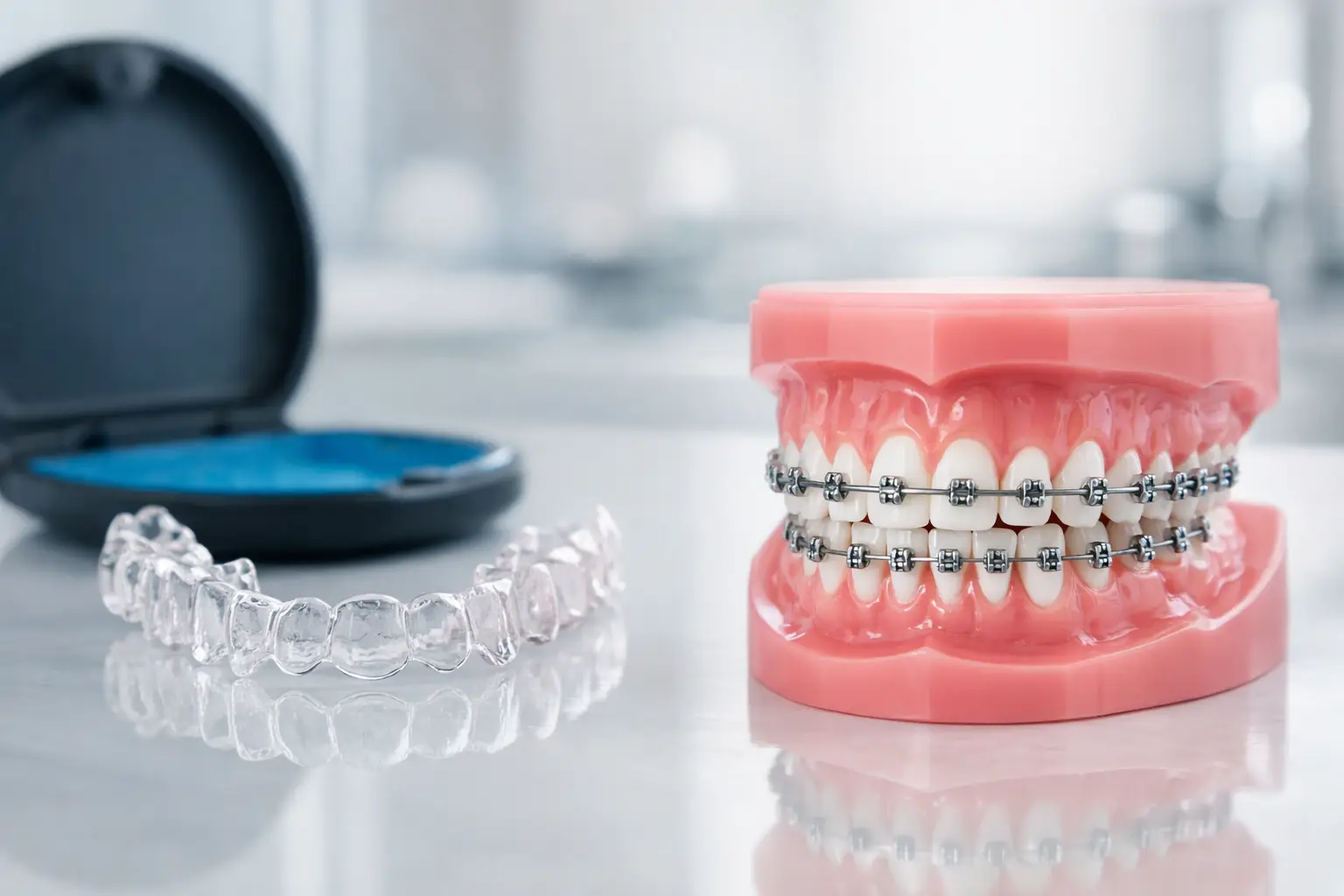
If you are weighing invisalign vs braces, you are probably asking a bigger question than how your teeth will look during treatment. You are also thinking about comfort, daily routine, cost, timing, and whether the result will truly fit your long-term oral health. That is the right place to start, because the best orthodontic option is rarely one-size-fits-all.
For some patients, Invisalign offers a more flexible and discreet way to straighten teeth. For others, braces provide the control needed to correct more complex bite or alignment concerns. Both can deliver excellent results when treatment is planned carefully and followed consistently. The key is understanding where each option tends to work best.
Invisalign vs braces: what is the real difference?
At the simplest level, braces use brackets and wires attached to the teeth to guide movement over time. Invisalign uses a series of custom clear aligners that are worn over the teeth and changed regularly as your smile shifts.
That difference affects almost everything else about treatment. Braces are fixed, which means they are always working and do not depend on remembering to put them back in. Invisalign aligners are removable, which gives you more freedom at meals and when brushing and flossing, but it also means results depend heavily on wearing them as directed.
Neither option is automatically better. The better question is which one fits your smile, your habits, and your treatment goals.
Appearance and confidence during treatment
This is often the first thing people notice when comparing invisalign vs braces. Invisalign is popular because the aligners are clear and low-profile. In day-to-day life, many people feel more comfortable speaking, smiling, and attending work or social events without the look of brackets and wires.
Braces are more visible, although modern braces are smaller and less bulky than many people remember. Some patients do not mind the appearance at all, especially younger patients who see braces as a normal part of orthodontic care.
If discretion matters to you, Invisalign usually has the advantage. If appearance is less important than treating a more involved alignment issue effectively, braces may still be the stronger option.
Comfort and adjustment
Both treatments involve pressure. That pressure is what moves teeth. The experience, however, can feel different.
With Invisalign, patients often describe the sensation as tightness when a new set of aligners is started. The edges of aligners can sometimes feel noticeable at first, but many people find the trays relatively easy to adapt to after the first few days.
Braces can create soreness after adjustments, and brackets may irritate the cheeks or lips until the mouth gets used to them. A broken wire or loose bracket can also cause temporary discomfort and may need attention.
For patients who want fewer sharp edges and a smoother appliance, Invisalign may feel more comfortable. That said, comfort is personal, and most people adapt well to either option with a little time.
What each option can treat
This is where the decision becomes more clinical.
Invisalign can be very effective for many common orthodontic concerns, including crowding, spacing, and certain bite issues. Advances in treatment planning have made clear aligners more capable than they were years ago. Many adults and teens are good candidates.
Braces still have an important advantage in some complex cases. Significant tooth rotations, major bite corrections, severe crowding, and movements that require very precise force may be better managed with braces. Because they are fixed to the teeth, braces allow for continuous control that can be especially helpful when treatment is more challenging.
A proper exam matters here. A treatment that looks more convenient on the surface is only worth choosing if it can predictably achieve a healthy result.
Daily life, meals, and oral hygiene
Daily routine is one of the biggest practical differences between the two.
With Invisalign, you remove the aligners to eat and drink anything other than water. That means there are no food restrictions in the usual sense. You can still enjoy crunchy vegetables, popcorn, or foods that would normally be off-limits with braces. You also brush and floss your teeth more normally, which many patients appreciate.
The trade-off is responsibility. Aligners need to be worn for the recommended number of hours each day, usually around 20 to 22 hours. If they stay out too long, treatment can slow down or become less predictable.
Braces stay on all the time, so compliance is less of an issue. But they do require more care around meals and cleaning. Sticky, hard, or chewy foods can damage brackets or wires, and brushing and flossing around braces takes more time and attention. If plaque builds up during treatment, it can affect gum health and leave marks on the teeth.
For patients who are disciplined and want flexibility, Invisalign can fit beautifully into daily life. For patients who would rather not worry about remembering trays, braces can be simpler in a different way.
Treatment time and follow-through
Many patients ask which option is faster. The honest answer is that it depends on the complexity of the case and how well instructions are followed.
In straightforward cases, Invisalign and braces may have similar treatment timelines. In some situations, braces may move teeth more efficiently, especially when more complex corrections are needed. In other cases, Invisalign can be very streamlined.
What often changes the timeline is consistency. Braces are working full time because they are fixed in place. Invisalign only works as planned when it is worn as directed. If aligners are frequently removed or forgotten, treatment can take longer than expected.
This is why lifestyle and personality matter. A good treatment plan should match not only your teeth, but also the way you are most likely to succeed.
Cost considerations
Cost varies depending on how complex the treatment is and how long it will take. In many cases, Invisalign and braces are in a similar general range, although one may be slightly higher depending on the details of care.
It helps to think beyond the initial fee. The value of treatment includes predictability, convenience, maintenance, and the likelihood that the plan will be followed well. The less expensive option on paper is not always the better value if it does not suit your needs or leads to delays.
Insurance coverage can also affect the decision. Some plans offer orthodontic benefits that apply to either treatment, while others may have specific limits. A clear estimate and a practical discussion of options can make the decision much easier.
Invisalign vs braces for adults and teens
Adults often lean toward Invisalign because it is discreet and easier to manage in professional or social settings. It can be a strong choice for people who are motivated, organized, and looking for a treatment experience that feels less visible.
Teens can also do very well with Invisalign, especially when they are committed to wearing the aligners properly. But braces can still be a great fit for younger patients who need more complex correction or who may struggle with keeping trays in consistently.
There is no age group that automatically belongs with one treatment. What matters more is the clinical need and how realistic the day-to-day routine will be.
How to choose between invisalign vs braces
A helpful way to decide is to think in terms of priorities rather than popularity.
If your main goals are discretion, easier brushing and flossing, and flexibility with food, Invisalign may be a strong fit. If your case is more complex, or if you want a treatment that does not depend on remembering to wear an appliance, braces may make more sense.
It is also worth considering your long-term oral health. Orthodontic treatment is not only cosmetic. Straighter teeth can be easier to clean, and a healthier bite can reduce uneven wear, improve comfort, and support better function over time. The best choice is the one that creates a stable, healthy result you can maintain.
At Victoria Park Dental, these conversations are most useful when they are personalized. A smile is not just a set of straight teeth. It is part of your comfort, confidence, and overall health, and your treatment should reflect that.
If you are deciding between Invisalign and braces, try not to focus on what is trendier or what worked for someone else. The right option is the one that fits your bite, your habits, and your goals well enough that you can see it through with confidence. A careful plan now can make everyday oral health easier for years to come.